I am an ESA App Camp Winner of 2012


Really, I am together with my great team members Stanislav, Hannah and Ognen (from left to right; on the right Mr. Thomas Beer, Policy Coordinator in the ESA GMES Space Office)!

esa_app_camp_winners_2012
Source: ESA 2012, http://spaceinimages.esa.int/Images/2012/06/App_Camp_winning_team

In last years June (17.06 – 22.06.2012) I was for the first time of my life in Italy. I visited the European Space Agency (ESA) together with a lot of european bright heads in app development from all over Europe. This event I was visiting was called the ESA App Camp (see screenshot of website) and it was the first such event for developers ESA ever organized. It was located in Frascati, Italy where ESA has one of its headquarters called European Space Research Institute (ESRIN) and at the same time ESA’s centre for Earth observation.

Our mission was:

Work diligently despite the Mediterranean heat to create applications for mobile phones that bring Earth observation and GMES services to the everyday user.

Yes, and that’s actually what really happened. It was absurdly hot (above 40 °C degrees outside). It was packed with mobile devices. Packed with a lot of ideas. And we got the latest and greatest data of earth observation to play with. And hell yeah we also got rockets! I met a lot of new people and tried to make some friends during this really short week that was crammed with new stuff. We got some very good insight into ESA’s operations and its future plans and i.e. the Global Monitoring for Environment and Security (GMES) program by our on site advisor Thomas Beer (who is ESA’s Policy Coordinator) and several other people – most of them scientists – of ESRIN.
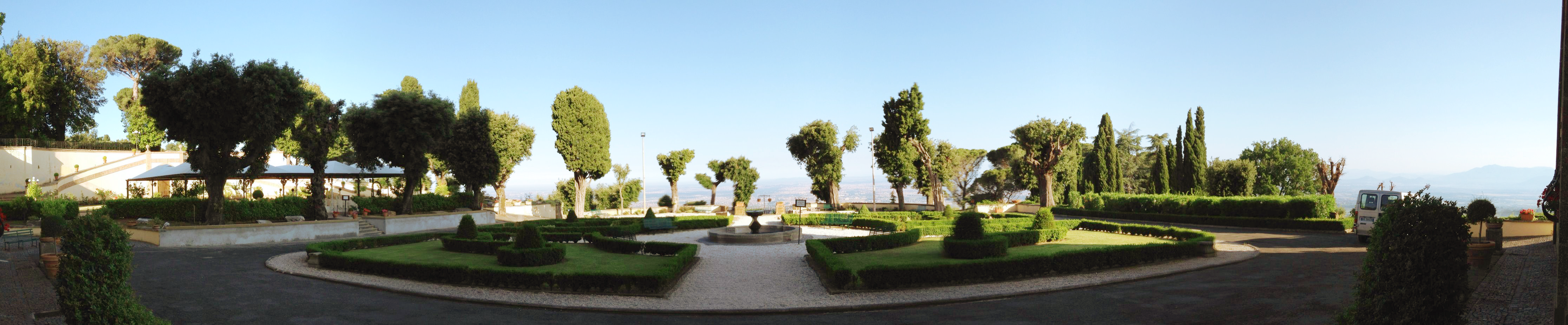

During our time there we stayed at the very nice Grand Hotel Villa Tuscolana in the mountains of Frascati. I took the above panorama picture standing in the main entrance doing a 180 with my iPhone right after sunrise (tap on the picture to see the HUGE version). As already mentioned it was quite hot in Italy, so the pool at the hotel was more than welcome, and warm clothing was normally really not needed. Normally! I emphasize that, because I needed some warm clothing for all the AirConditioning going on. ;-)
esa_app_camp_2012_participants
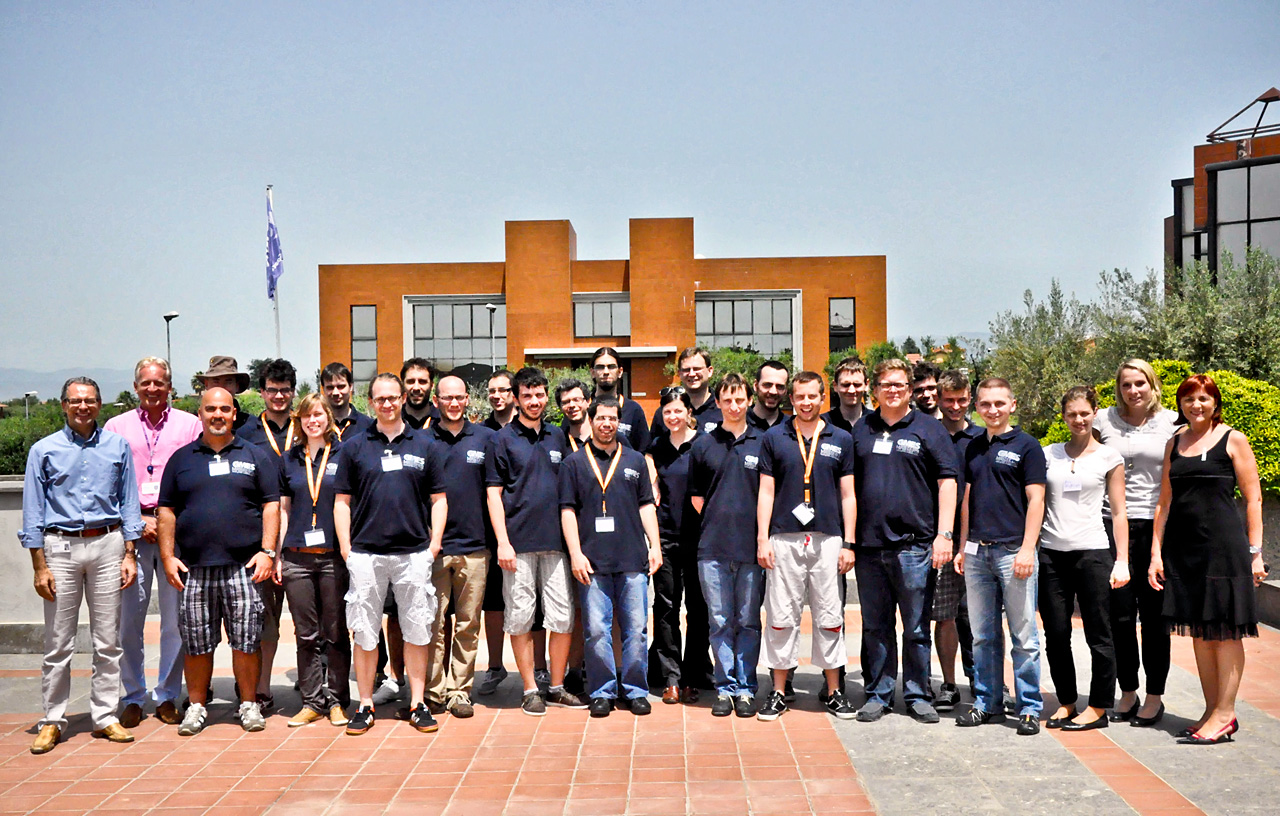
Source: ESA 2012, http://spaceinimages.esa.int/Images/2012/06/App_Camp_participants, shows all participants of the App Camp and ESA staff on site in Frascati

So what happened at this App Camp about you ask? Well, 20 people got a huge amount of input about what ESA is about, what these guys are working on right now, and what they have already prepared for us european citizens and which you will recognize soon as the launch of Sentinel 1, 2, 3, 4 and 5 satellites will happen. If they are labeled A or B there are two of each one to have a backup system ready.

This week was pretty packed. I think the first two days we really got a lot of basic info about what’s going on at ESA and what GMES is and why we are invited to craft some apps and/or ideas. As soon as we had enough info to get an idea about which kind of data would be made accessible for us if we plan to create an app, we were ready to start thinking.
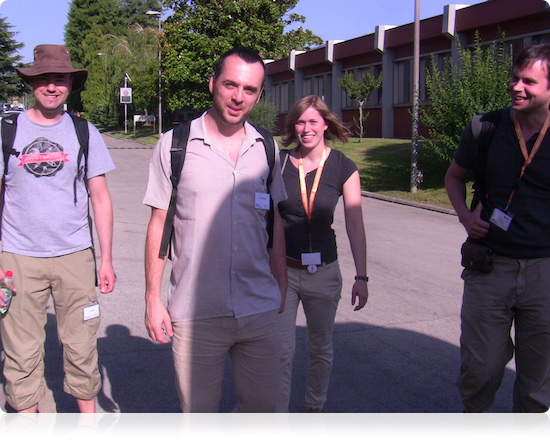
esa_app_camp_2012_winners_after_work
Source: Own photograph; my team members including myself in sunny Italy/Frascati

…to be continued…

Stanislav also has a nice blogpost about it with lots of photos!

Update 15.2.2013
There is a new ESA App Camp starting right now with a Call for Participants
#pdftribute

As a tribute to Aaron Swartz I put up a copy of his „Guerilla Open Access Manifesto“ here:

Guerilla Open Access Manifesto

Information is power. But like all power, there are those who want to keep it for themselves. The world’s entire scientific and cultural heritage, published over centuries in books and journals, is increasingly being digitized and locked up by a handful of private corporations. Want to read the papers featuring the most famous results of the sciences? You’ll need to send enormous amounts to publishers like Reed Elsevier.

There are those struggling to change this. The Open Access Movement has fought valiantly to ensure that scientists do not sign their copyrights away but instead ensure their work is published on the Internet, under terms that allow anyone to access it. But even under the best scenarios, their work will only apply to things published in the future. Everything up until now will have been lost.

That is too high a price to pay. Forcing academics to pay money to read the work of their colleagues? Scanning entire libraries but only allowing the folks at Google to read them? Providing scientific articles to those at elite universities in the First World, but not to children in the Global South? It’s outrageous and unacceptable.

„I agree,“ many say, „but what can we do? The companies hold the copyrights, they make enormous amounts of money by charging for access, and it’s perfectly legal — there’s nothing we can do to stop them.“ But there is something we can, something that’s already being done: we can fight back.

Those with access to these resources — students, librarians, scientists — you have been given a privilege. You get to feed at this banquet of knowledge while the rest of the world is locked out. But you need not — indeed, morally, you cannot — keep this privilege for yourselves. You have a duty to share it with the world. And you have: trading passwords with colleagues, filling download requests for friends.

Meanwhile, those who have been locked out are not standing idly by. You have been sneaking through holes and climbing over fences, liberating the information locked up by the publishers and sharing them with your friends.

But all of this action goes on in the dark, hidden underground. It’s called stealing or piracy, as if sharing a wealth of knowledge were the moral equivalent of plundering a ship and murdering its crew. But sharing isn’t immoral — it’s a moral imperative. Only those blinded by greed would refuse to let a friend make a copy.

Large corporations, of course, are blinded by greed. The laws under which they operate require it — their shareholders would revolt at anything less. And the politicians they have bought off back them, passing laws giving them the exclusive power to decide who
can make copies.

There is no justice in following unjust laws. It’s time to come into the light and, in the grand tradition of civil disobedience, declare our opposition to this private theft of public culture.

We need to take information, wherever it is stored, make our copies and share them with the world. We need to take stuff that’s out of copyright and add it to the archive. We need to buy secret databases and put them on the Web. We need to download scientific journals and upload them to file sharing networks. We need to fight for Guerilla Open Access.

With enough of us, around the world, we’ll not just send a strong message opposing the privatization of knowledge — we’ll make it a thing of the past. Will you join us?

Aaron Swartz

July 2008, Eremo, Italy

At the same time I link to my dissertation (german language) document as PDFtribute right here. I link also to the words of his former girl friend which knows and loves him perhaps more than anyone else. She writes

„More than anything, together we loved the world, with the kind of love that grips and tears.“

Update Jan 16th, 2013
Adding the link to the blog of the internet archive just for convenience, and a link to „Scientific Collaboration on the Internet“ edited by Gary M. Olson, Ann Zimmerman, and Nathan Bos for obvious reasons.
Full list of additional stuff to read:

LIFT09: How getting close, doubles your activity

lift09_bannervertical_v3.png

In February 2009 I will give a first time visit to the LIFT-Conference 2009 in Geneva/Switzerland. I closely followed the latest conferences and always wanted to visit one by my self. Now I have the money which allows me to afford visiting this hopefully inspiring event in the upcoming year. I registered in mid of November as an early bird.

I think that it is a very good idea to give guests of LIFT09 the choice to perhaps be part of a workshop around new ways of non-verbal communication on the WWW: Virtual Proxemics. So I setup a workshop offer for people who plan to visit LIFT09 and I would like to invite you all to have a look at the description of my workshop offer.

In the workshop I will ask „Are we all condemned to loneliness on the WWW?“ and at the same time I would like to offer some insight that „Providing context to feel closer to each other“ might be an improvement. „Discussing possible fields of application for virtual proxemics“ will be the creative and thought provoking part of this workshop with a goal to kick off a Proxemic Information Think Tank (PITT).

Workshop at LIFT09
Virtual Proxemics: How getting close, doubles your activity

More: See a list of all workshops the official program and all open stage talks. Even more information can be read in the virtual magazine shelfspace of issuu.com.

Let’s see, if we could figure where the future is!
I hope I catched your attention, see you all at Geneva 2009.

Helge
:-D