
Weeks ago I announced to publish an idea of how to measure “2.0″. Being at the frontier of science, technology and learning with my blog thetawelle now for several years, I repeatedly asked myself how can I measure “2.0″. Everywhere you can read about “Web 2.0″ since Tim O’Reilly coined this buzzword and later on – afaik – registered it as a trademark, when he realized, that it was the ultimate joker addressing everything new, unknown and totally hip tech-stuff in the cyberspace.
The Longtailed´ness is one of 5 important criteria for measuring if some service is 2.0. Following the motto “Little sheep give wool too” technological change introduced “The age of endless shelf-space”. The networked world created even for smallest demands niches big enough to create a market and to allow existence of a supplier for this demand.
The “Longtail” can easily be translated as “Little sheep give wool too” – but it should be added “…if you have enough of those little sheep”. Internet created a situation, where many people find a new space to meet each other. Also demand and supply increasingly meet each other more often on the net than anywhere else.
If millions of people travel the net, also millions of desires and niches pop up. Even the scariest or funniest or unimaginable ideas and requests will find more than one person on the net representing them. Niches are created everywhere through aggregation of those following these niche-subjects until the critical mass lets pop up a new internet-page -blog or -service for exactly this new niche.
Since the factors explained here should be clear catalysts of a dynamic of change and creation the longtailed’ness seems to be one of the most important factors among them. Longtailed’ness skyrockets because the costs of supply and demand meeting on the net decreased to nearly zero. Search-engines e.g. are one of the most important driving forces behind the creation of new niches, which might give birth to the next new web-service.
Sources of inspiration
- The Long Tail, Chris Anderson (blog) in an article for wired.com
- Endless shelf space (PDF), „Outlook“ Special Edition: The eSeries, Accenture
- A Paradise of Choice? – American Scientist/Sigma Xi, The Scientific Research Society
- Bekanntmachung des Bundesministeriums für Bildung und Forschung von Richtlinien zur Förderung von Vorhaben zur Weiterentwicklung und zum Einsatz von Web 2.0 Technologien in der beruflichen Qualifizierung – Federal Ministry of Education and Research, Germany (BMBF)
Update 15.7.2008
One of the best examples of how the longtail changes the way things work can be recognized in the path development of german music tv took. Since MTV, VIVA and others changed their program to ringtone-ads and us-funshows music as one of the main youth-media just changed over to the internet. The german magazine „Stern“ has now some really nice article „Musikfernsehen im Internet – Die Erben von Kavka und Kuttner“ about this and many interesting links which point far away along the tail. Some examples: c-tube, balcony TV, bunch TV and Motor TV are filling the gap of the missing link for music video fans now.
 Why do I blog this? Everywhere around me people were thinking about how the web might change their business. One of these „people“ was the library (SUUB) of Bremen. These people are searching for what to do and what to change to be successful. Also politicians think about how to support science and companies to develop new, persistent and successful web2.0 services. But no one of those I met, asked what the driving forces behind Web2.0 are. I will try to shed some light upon this question in this part and the remaining 3 plus 1 parts about measuring 2.0, and I hope for some insightful comments. I do not think that I have found the ONE and only truth here, but instead I try to stand on the shoulders of giants. Longtailed’ness seems to be a trivial part – which is why I chose to start with this one – but there are four other parts of the 4+1 in total waiting to revealed soon…

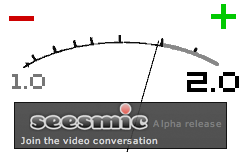 Doch was für Dinge sind das? Und wenn es sie nun tatsächlich gibt, wie kann ich 2.0 messen um den Skeptikern etwas Nachvollziehbares anzubieten? Diese Fragen haben mich beschäftigt und ich denke seit längerem über ein Modell bzw. ein konkretes Instrument nach, wie man das machen kann. Meine Bemühungen sind mittlerweile weiter vorangeschritten und ich denke, dass ich ein kleines Messinstrument habe, das funktionieren wird.
 Why do I blog this? Mein Messinstrument nimmt langsam konkrete Formen an. Derzeit überlege ich, wo ich es eventuell dauerhaft zum Einsatz bringen und veröffentlichen kann. Vielleicht ergbit sich eine Möglichkeit in einem demnächst neu erscheinenden Magazin, dem