Die Anzahl der Passwörter die man so für verschiedene Services (die oft per App oder Web erreichbar sind) in Betrieb hat lässt sich ja durch einige Tools mittlerweile ganz gut in den Griff bekommen.
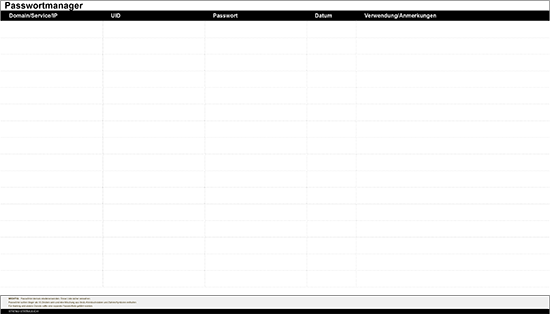
Doof sieht es aus für Dienste und Zugänge aus, die z.B. UNIX-User-Accounts oder spezielle andere Dienste-Accounts anbieten, die eben keinen normalen Webzugang oder App-Zugang haben. Dafür hab ich mir jetzt mal ein Template für einen papierbasierten Passwortmanager (als PDF,als HTML) gemacht.
Ich weiß das schaut eventuell komisch aus im 21igsten Jahrhundert Passwörter auf Papier zu notieren. Aber was Besseres ist mir nicht eingefallen. Und so kann ich z.B. pro Maschine/Rechner alle Accounts (z.B. für eine lokale mySQL oder WordPress Installation, oder auch für Passphrasen von Key/Cert-Kombinationen etc.) auf einer DIN A4 Seite festhalten.
Why do I blog this? Ich dachte echt mir passiert das nicht, ein Fallback auf toten Baum, aber es ist einfach eine praktische Methode. Deutlich besser als meine bisherige, Passwörter sporadisch in irgendwelche Kladden zu notieren und sich dann später einen Wolf zu suchen danach. ;-)
Von daher, wer da auch Bedarf hat, kann das Teil gerne ausdrucken und nutzen.
…geht eigentlich nicht. War für mich die letzten Jahre kaum vorstellbar den Congress auszulassen. Doch der 30c3 (in 2013) mit den Snowden Veröffentlichungen war schockierend.
Einen Gang runterschalten
Seit dem bin ich zögerlich den Congress weiterhin zu besuchen. Wenn man sich immer nur auf Fails und Probleme konzentriert, beleibt irgendwann der Optimismus auf der Strecke. Das macht schlechte Laune und zum Jahresausklang wünscht man sich auch ein wenig Positives.
So habe ich dieses Jahr den Congress sausen lassen. Auch weil das Camp so überragend gut war, dass ich vermutlich nur enttäuscht gewesen wäre. Dennoch wollte ich bei der Familie zu Haus unterm Tannenbaum zumindest die Talks ein wenig verfolgen.
Keynote? Welche Keynote?
Mit der Keynote scheint der Club in letzter Zeit kein Glück zu haben. Ich weiß nicht was mir die Keynote sagen sollte, außer dass da jemand stand der sichtlich auch mit dem Club nichts anfangen konnte und stattdessen sogar Vorwürfe machte, hinterließ Fatuma Afrah offenbar nicht nur bei mir, sondern auchbeianderen, viele/nur Fragezeichen.
Talks live & relive
Die Talks habe ich versucht während des Congress LIVE per iPhone zu gucken und sonst per RELIVE, was weitgehend gut geklappt hat, wobei ich das iPhone mehrfach mit dem Lounge Stream belegt habe und versuchsweise die 32c3 app auf dem Apple TV zum Gucken probiert habe einzusetzen… das funktionierte eher so mäßig. Letztlich hab ich doch mit VLC auf dem Rechner geguckt, weil die Streams im Apple TV scheinbar höhere Auflösung/Bandbreite forderten als ich flüssig von Kabeldeutschland bekomme und auch nicht zwischen SD/HD wählen konnte.
Download der Talks
Da mir diese ganze App’isierung der Streams dann doch recht bald ziemlich auf den Senkel ging, man kann z.B. nicht markieren was man schon gesehen hat — auf dem Mac mache ich dann einfach ein Etikett GRÜN dran wen ich was fertig gesehen habe — und man kann das Abspieltempo nicht beschleunigen auf z.B. 1,4fache Geschwindigkeit, möchte ich die anderen Talks lieber per VLC auf dem Rechner sehen.
Wer für den Download per RSYNC ein Stück Code benötigt, hier (gist):
Das sind etwas mehr als 83 GB an Content für die HD Versionen, man sollte also genug Platz auf dem Volume haben auf das man das synced.
Ich hoffe der CCC hat seine Einnahmen aus Mitgliedschaften etc. mal so kalkuliert, dass Downloadtraffic auf dem Media CDN Server gut verkraftet & bezahlt werden kann.
Wiki Fail
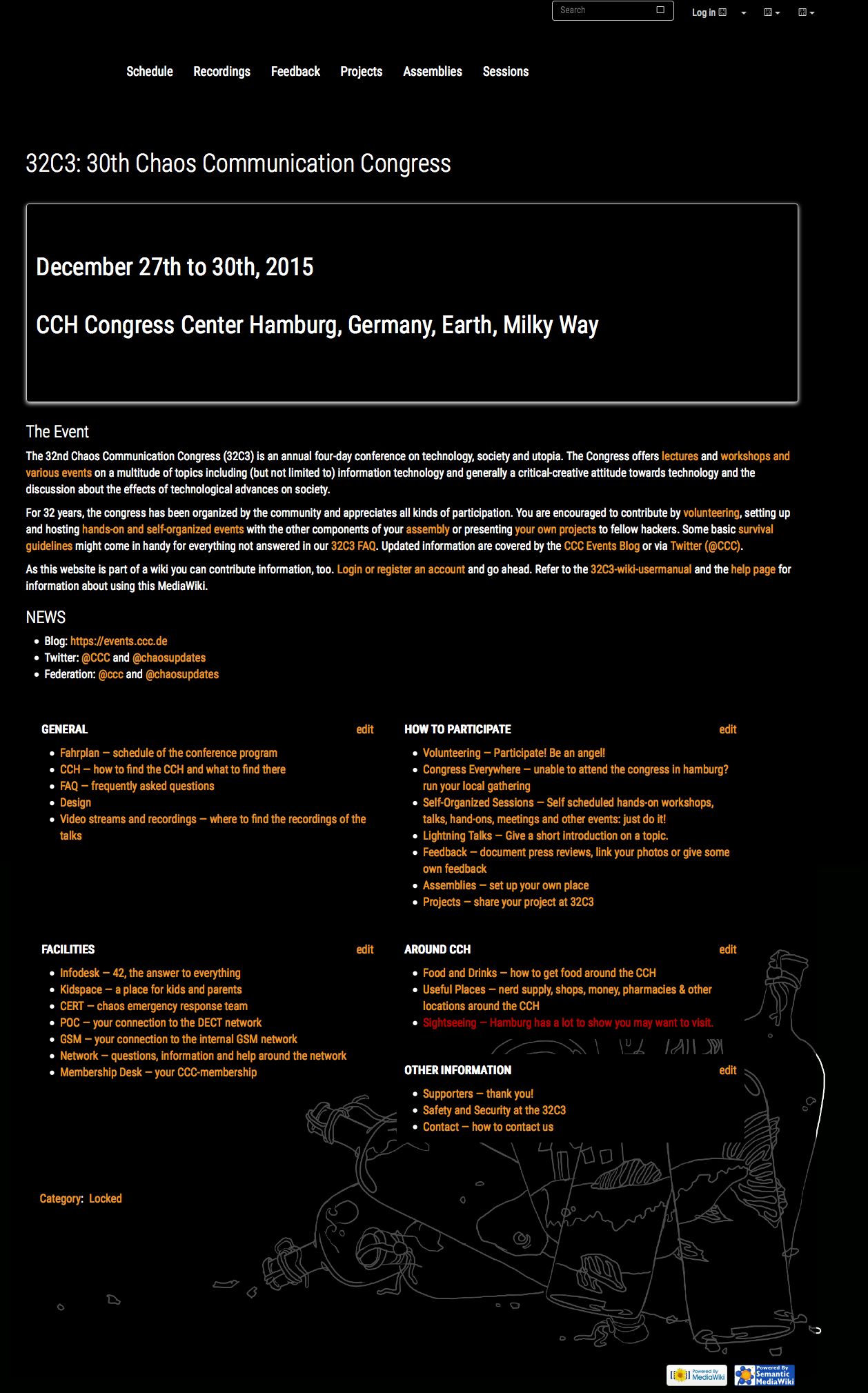
Das Congress Wiki ist ja bislang eigentlich fast immer das erste Opfer des Congress an Tag 1 gewesen. Dieses Jahr war es wohl weniger wegen technischer Unzulänglichkeiten des Caching nicht verfügbar sondern vielmehr, weil man eine Attacke nicht korrekt abwehren konnte. Heute hab ich das Wiki tatsächlich zum ersten Mal online gesehen in voller Pracht. Daher schnell ein Screenshot, bevor es wieder weg ist…
The Ultimate Amiga 500 Talk
Für alle Amiga Fans ein Muss, es geht nicht nur um den 500er und es werden viele Details erwähnt die ich nicht kannte; teils recht technisch
Auch nachdem ich dem 32c3 fern geblieben bin, bin ich überzeugt das Richtige gemacht zu haben. Mal wieder Familie und Freunde um sich zu haben zum Jahreswechsel ist deutlich weniger anstrengend und deutlich konstruktiver und erbaulicher, als sich durch die ganzen Security Fails schlechte Laune machen zu lassen. ;-)
Ich fand die Vorträge qualitativ alle relativ gut, die ich bisher gesehen habe. Diesen Volkswagen-Vortrag fand ich einfach nur Trittbrettfahrerei und eines CCC nicht wirklich würdig. technisch sicher brilliantes Reverse Engineering, aber man muss sich ja auch mal fragen wozu jetzt eigentlich noch? Was hat es gebracht außer bissel harten Spaß für den Hacker der es gemacht hat?
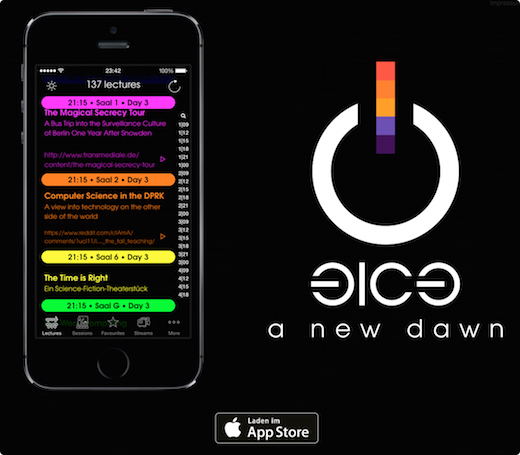
Mit abgeklärtem Told-you-so-Blick habe ich zur Kenntnis genommen, dass der 31c3 tatsächlich Peak iOS App war. Ich hab nicht intensiver gesucht, aber ich meine dieses Jahr gab es nur noch EINE einzige iOS App, letztes Jahr waren es noch 4 oder gar 5 verschiedene.
Das App-Angebot des 32c3 ist dann wohl die traurige Konsequenz aus dem Nicht-Zusammenarbeiten-der-Entwickler und der geringen Bereitschaft von CCC-nahen Entwicklern echtes Open Source zu praktizieren, denn auch dieses Jahr war die App nicht Open Source, Gratulation an den Club!
Ich hab keine App entdeckt, die wie meine 31c3-App Wiki-Informationen bereitstellte, diese hätte aber wohl dieses Jahr wegen dem DDoS auch einige Probleme gehabt. Ich stell trotzdem nochmal für den 33c3 meine Wiki-Scripte hier bereit als Link.
Why do I blog this? Ich find es super, dass die Streams so klasse stabil sind und die Content-Bereitstellung so grandios schnell geht. Meine Favoriten an Talks trage ich dann hier in Kürze mal nach.
Wie üblich fasse ich hiermit nur meinen subjektiven Senf zum Congress zusammen. Leider hab ich über das CCCamp 2015 noch nichts geblogged. Wird wohl auch nichts mehr werden. Es war schlicht zu gut, um die Erinnerung daran jetzt mit Blogging „kaputt“ zu machen. :) Aber hier hat mal jemand meine primäre CCCamp Erfahrung gut repräsentiert. Auch dieses Video gibt einen guten Überblick.
I have some history in using databases. From using Oracle, Frontbase, mySQL, PostgreSQL, sqlite etc. the last time I used a database was for a postcard app using CoreData. But I found CoreData to be a lot of overhead and boilerplate code to write.
Especially migrations are kind of not very intuitive to understand and if something goes wrong you are basically lost. While Xcode for a while had an Entity modelling tool (which had it’s roots in the WebObjects EOModeler), most of the time this tool did not work very well for me and had lots of bugs. In each Xcode version different bugs!
Also many people report running into issues when using CoreData with lots of objects, because it is easy to loose track of memory consumption with CoreData and if you do not actively check and work against that, you end up with a whole model graph being in memory. Not cool! So I wanted to try something different.
Realm
I found Realm by Realm.io to be interesting enough to tinker with. So I started working with their sample code projects. But none of those projects came even close to some real world example. So I just started prototyping something I will need for a different project anyway.
Starting with a custom viewcontroller for adding & editing entities I recognized that this would soon become rather painful to provide e.g. inputfields for text and numbers and dates. So I grabbed FXForms to give it a try after I had already completed a viewcontroller to manage DBCaptain entities a bit.
Migrations
Right from the start I wanted to know how migrations work. Because usually those are the weakest spot in every db operation taking place. With a live product you always „pray“ that nothing will go wrong during migrations on the customers device. And keeping track of changes to the db schema is very important to have a stable app.
So I built the sample around the process to „simulate“ an app in development. You can now iterate through different development steps (5 different app states & their migrations) and their needed migrations. This way I figured out how I can safely manage my migrations (i.e. always keeping a backup of the old schema). In the project the DatabaseFactory.m class manages all that. It detects existing schemas using a precise naming scheme for each Realm-db created.
During app launch any necessary migrations are executed if necessary. Also, any errors happening while the app launches and gets into trouble activating the database, are nicely displayed.
Create/Insert/Edit/Delete
I started with one entity DBCaptain which is basically a user entity. I just wanted to create user objects and populate them with different properties. I tested insertion with one and with many users on the main thread and on the background thread. I also took advantage of notifications coming from Realm as soon as an operation finished updating the db.
Deletion of objects came next. As always having the UI keeping track of all those changes is the more difficult task. So expect some „ugly“ code, because this was only me tinkering around. When i wanted to edit existing objects I recognized that I do not want to create all those textfields manually.
FXForms
That was when FXForms came to the rescue. I started to recreate the already half done viewcontroller and created another based on FXForms. I needed some time to wrap my head around FXForms, because basically this is a quite sophisticated hack of providing compact descriptions of UITableViewCells and their content.
You describe what kind of structure your form should have and what kind of value types it should use. FXForms crafts the UITableView which makes all those inputfields come true. Things start to become a bit tricky if you want to control those UITableViewCells more directly. E.g. I needed a way to exclude certain properties of being edited at all. So I simply extended the FXForms protocol to allow for a denial of userInteractionEnabled on certain cells by adding the FXFormFieldEditable key. This is used on the CaptainFormViewController to exclude the information about the database schema and the encryption status to not be editable.
Evaluation
My first impression of Realm DB is quite positive. It is fast, it provides helpful error-messages and it is easy to setup and comprehensive in what it does and how it works. I never in my life had migrations up and running that quickly. Very, very helpful was the Mac app RealmBrowser to open a realm DB file directly. I used that while checking my migrations and the results of operations which added arbitrary data (e.g. image files).
What is actually really great is that encryption is supported for the db by just providing a 128 bit key. That is really helpful to protect user data and increase safety of the realm db file even if it gets backed up into some cloud somewhere else.
What’s next?
I think I missed something related to the KVO-thingy going on by Realm. But I had no time until now to figure that out. I suppose they actually track entities and changes via KVO. But I am not yet sure how exactly this works and how I can detect if an object has pending changes. That is why I added a hasPendingChanges BOOL-flag to both ViewControllers for editing entities. So help is welcome here!!
I did not have time to do some real hardcore performance testing, i.e. adding thousands of entities and relationships in a short time and crafting a rather complex model with complex relationships which define ownership and cascading deletions etc. Also doing sophisticated db queries is on my list to do next.
But having a prototype now to tinker with helps already a lot. Since I learn best from sample code, and I think I am not the only one learning new things this way, I hope it helps others to jumpstart with Realm, too.
Why do I blog this? I just wanted to give a bit of background info on the sample code I put on github. Have fun tinkering & I am really in need of getting more info on how I can detect changes to an object so I know WHEN to save changes to the db. Maybe someone who already grabbed the concept better can help me here?? Leave a comment or contact me via github.